Confession and Self-Criticism Rules in Revolutionary Reeducation
The SympathizerConfession and Self-Criticism Rules in Revolutionary Reeducation make confession both a political instrument and a literary examination. In the camp, the narrator must repeatedly revise an account of his life until it displays the approved ideology in an approved voice. The Commandant insists that content alone is insufficient: diction, cultural allegiance, class consciousness, and even the shape of a sentence become evidence of whether the writer has been remade. The procedure demands a particular self, not merely a particular admission, and the narrator’s inability to produce it prolongs his confinement.
The Confession as Examination
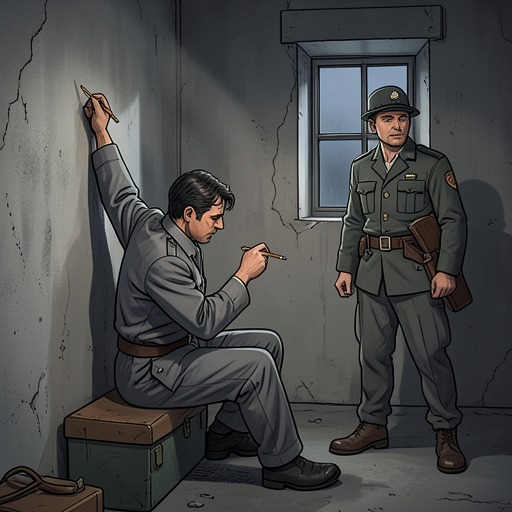
The narrator spends a year in a windowless isolation cell, permitted to emerge for only an hour of exercise each day, while rewriting successive versions of his confession. The Commandant reviews the document in weekly meetings, marking errors and urging him to delete, excise, reword, or add. By the time the Commandant lays out the latest draft, it follows 294 earlier pages. Its length records the duration of the process, but does not satisfy its examiner: the Commandant says the confession is not yet satisfactory and must serve as the prelude to a further, oral examination.
The Commandant frames this confinement as treatment rather than punishment. He calls the narrator a patient exposed to dangerous foreign ideas, someone who must be quarantined lest those ideas infect a society supposedly unprepared for them. He also calls him a guest, even though the narrator has been isolated for a year and cannot leave. The shifting labels turn political detention into an ostensibly benevolent process of diagnosis and cure. The Commandant’s language makes the institution’s authority sound protective while preserving its power to decide when the narrator is well.
The narrator is treated as a special case within the camp. He has not met the commissar, who appears to inmates only at weekly political lectures, and is exempted from those elementary lessons. Instead, he is assigned writing and reflection. The distinction gives his examination an appearance of intellectual privilege, but his isolation and the Commandant’s edits make clear that this privilege is also a form of control. The desired result is not simply a confession on paper: it is a person whose self-description can pass the authorities’ test.
Style, Culture, and the Approved Self
The Commandant states the standard plainly: “Confessions are as much about style as content.” In his view, the narrator may acknowledge experiences and deeds, but his writing does not yet express the correct political consciousness. The document must be clear, succinct, direct, and simple. Its language should be accessible to ordinary people rather than retain what the Commandant identifies as the habits of an elite intellectual. He condemns its individualism and Christian superstition, and finds too little belief in collective struggle, historical necessity, or sacrifice for the nation and the people. His instruction culminates in a demand that is simultaneously stylistic and political: “You must write for the people!”
Cultural references become part of the same examination. The Commandant objects that the narrator quotes Uncle Ho only once, omits the revolutionary poet To Huu and familiar folk sayings, and cites Pham Duy and the Beatles instead. The narrator’s selection of music and literature is treated not as personal taste but as proof of Western contamination. The Commandant contrasts those influences with revolutionary poetry and a traditional saying about revering one’s mother and respecting one’s father. When the narrator explains that his confession honors his mother but cannot honor his father, the expected formula of filial respect collides with his particular family history. The Commandant recognizes the difficulty, yet interprets it through the idea that the narrator must choose a side.
That demand turns the confession into an effort to simplify a divided life. The narrator was born in the north and lived there for nine years, but chose the southern side; the Commandant nevertheless insists that he shares a common culture with him. He describes the narrator’s divided perspective as a talent that conflicts with his fate and suggests that choosing one side is the cure for being a bastard. The diagnosis treats ambiguity itself as a defect. What the narrator experiences as the capacity to see from two sides, the authorities read as evidence that he has not yet submitted to the single political position the confession must perform.
Self-Criticism and the Limits of Compliance
The narrator understands that a formulaic confession could shorten his stay. He can say aloud that he has been contaminated by the West and believes in the political slogans the Commandant expects, yet cannot bring himself to inscribe the required clichés. He resists not by rejecting every revolutionary claim but by refusing to make his written account imitate a predetermined answer. The distinction is central to the process: verbal assent during an interview does not substitute for the written act of self-reconstruction demanded by the Commandant.
The Commandant’s criticism also makes class a test that the narrator cannot easily pass. He contrasts southern abundance, including beefsteak, with the starvation rations endured by northerners, and says the narrator’s repeated revisions have not removed bourgeois inclinations. He calls for collective consciousness and revolutionary sacrifice, then judges the narrator’s language as a sign of elite formation. Even when the narrator responds that the Commandant speaks truthfully, he asks what the Commandant would say about Karl Marx, whose writing is not simple or directed to the people. The Commandant treats the comparison not as a literary argument but as further proof of bourgeois presumption, ending the discussion by insisting that the commissar will cure the narrator’s elitism and Western inclinations.
The Commandant’s own advice exposes the coercive logic beneath the language of education. He says that the other prisoners tell him what they think he wants to hear, but that what he wants is sincerity; then he defines education as getting a student sincerely to say what the teacher wants to hear. The rule asks the narrator to make an imposed account feel like his own. Its demand for sincerity does not allow independent judgment; it makes the subject responsible for internalizing the examiner’s desired conclusion.
Repetition Beyond the Camp
The confession system is not confined to the narrator’s year in isolation. After his return to Saigon, he and his companions must still submit periodic confessions to local cadres, although they have done nothing since returning. They invent minor offenses, such as failing to show sufficient enthusiasm at a self-criticism session, while avoiding anything more serious. Each account ends with the prescribed assertion that nothing is more precious than independence and freedom. The routine makes confession a continuing civic performance: even inactivity must be given an ideologically acceptable explanation.
The recurrence clarifies the rules’ lasting effect. Confession can be made to register compliance without revealing a genuine political or personal transformation; the returned exiles describe their later statements as exercises in fiction. In the camp, the narrator’s refusal to write the expected language keeps him under examination. Outside it, the compulsory formula survives as a ritual that people can reproduce while withholding their actual experience. Across both settings, self-criticism is less a private search for truth than a regulated form of speech in which the authorities set the terms of acceptable memory, responsibility, and belonging.